Built on Strike Builder Connect

Strike perps,
anywhere Cardano lives.

One HTML tag puts Strike's order book inside any wallet, dApp or community. Users connect the wallet they already have with a single signature; partners earn Strike builder fees on every fill, tracked on a dashboard that checks volume against Strike's own history.

31
live Strike markets
—
Strike 24h volume
1
signature to start
57 KB
one script, no deps
Builder fee 0.05% · shown before every trade
Trading key can't withdraw
Live data
How it works

From one tag to builder fees in four steps

Hover a step to see what happens under the hood. Every call goes from the user's browser straight to Strike; no server ever holds a trading key.

01 / EMBED

Drop in one tag

Add the script and a <strike-trade> tag with your builder code.

Hover to reveal
  • Shadow-DOM web component: host CSS can't break it
  • Strike's own design language: chart, order book, stop & TWAP orders, ~57 KB gzipped
  • Live mark prices and funding for every Strike market via WebSockets
<strike-trade builder-code="…">
02 / CONNECT

One signature

Users pick Lace, Eternl or any CIP-30 wallet and sign once. Strike creates the account.

Hover to reveal
  • Browser generates an Ed25519 trading key
  • Wallet signs Strike's consent (fee cap, key, builder) via CIP-30 COSE
  • New wallets are detected and told about Strike's first-deposit rule up front
POST /auth/builder/verify-signature
03 / TRADE

Deposit & trade

ADA deposits are checked before signing; orders carry the partner's builder fee.

Hover to reveal
  • Strike builds the deposit; the widget decodes it: exact ADA, one output, no tokens
  • Wallet witnesses spliced byte-for-byte, so the tx id never changes
  • Market/limit, TP/SL, leverage, liquidation estimate, all fees shown first
X-Builder-Fee-Bps: 5
04 / EARN

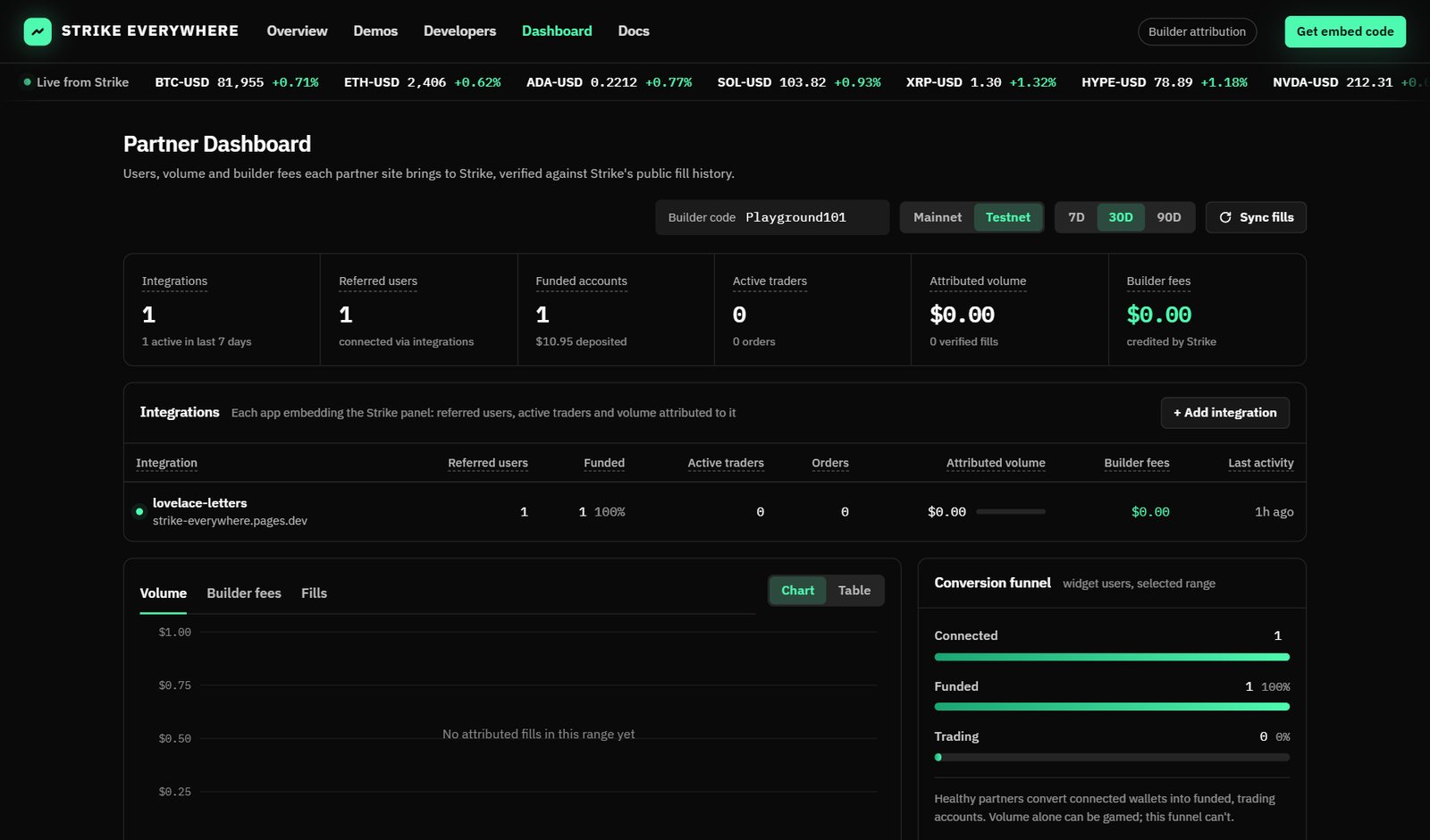
Verified volume

Strike charges your builder fee on every fill. The dashboard shows which partner site the volume came from.

Hover to reveal
  • Volume: Strike's public fills on orders the widget registered first
  • Funded: settled deposits in Strike's history; connected is widget-reported
  • Builder fees computed as notional × fee bps
GET /v2/history/fill?account_id=…
Live demos

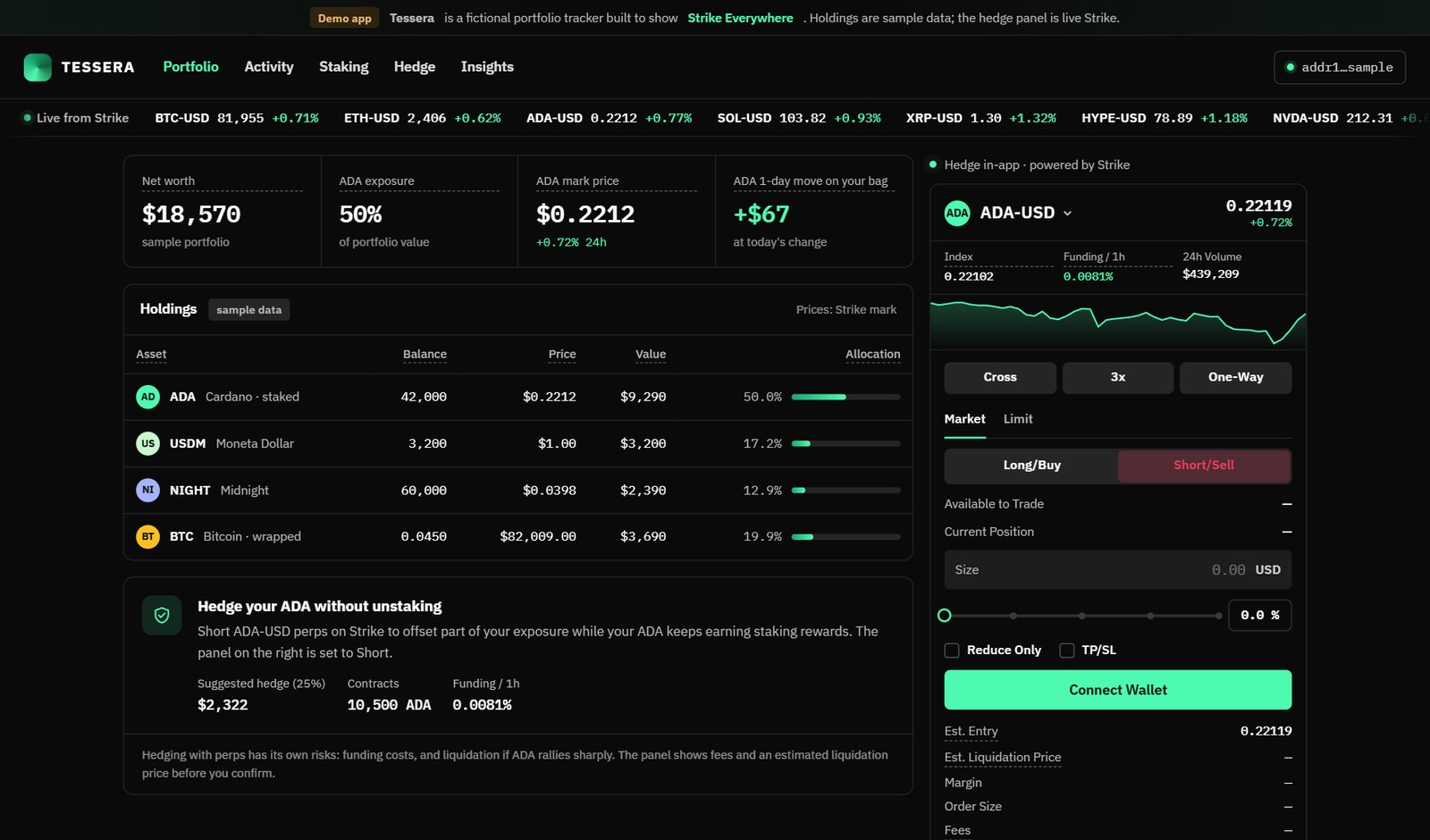
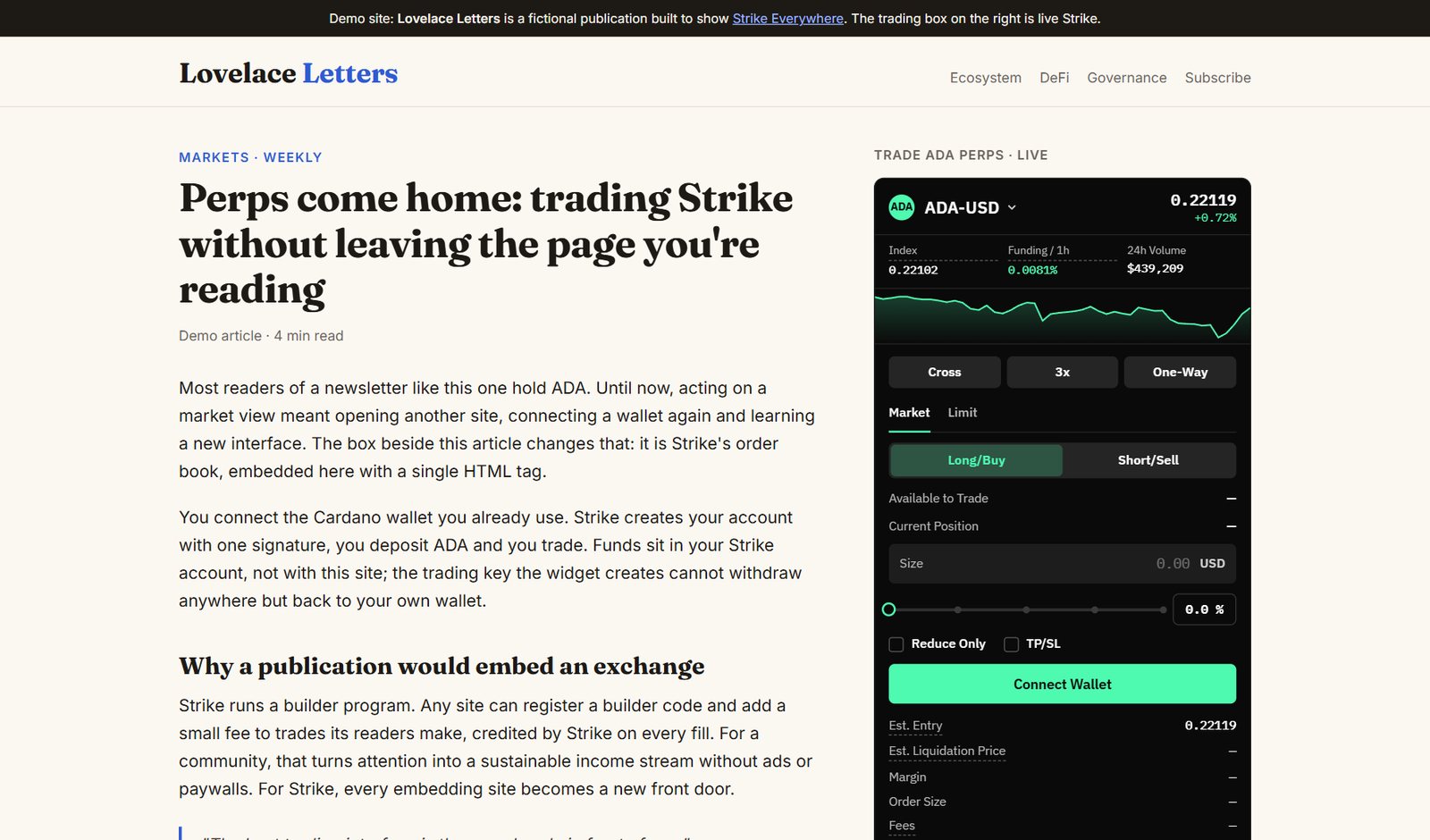
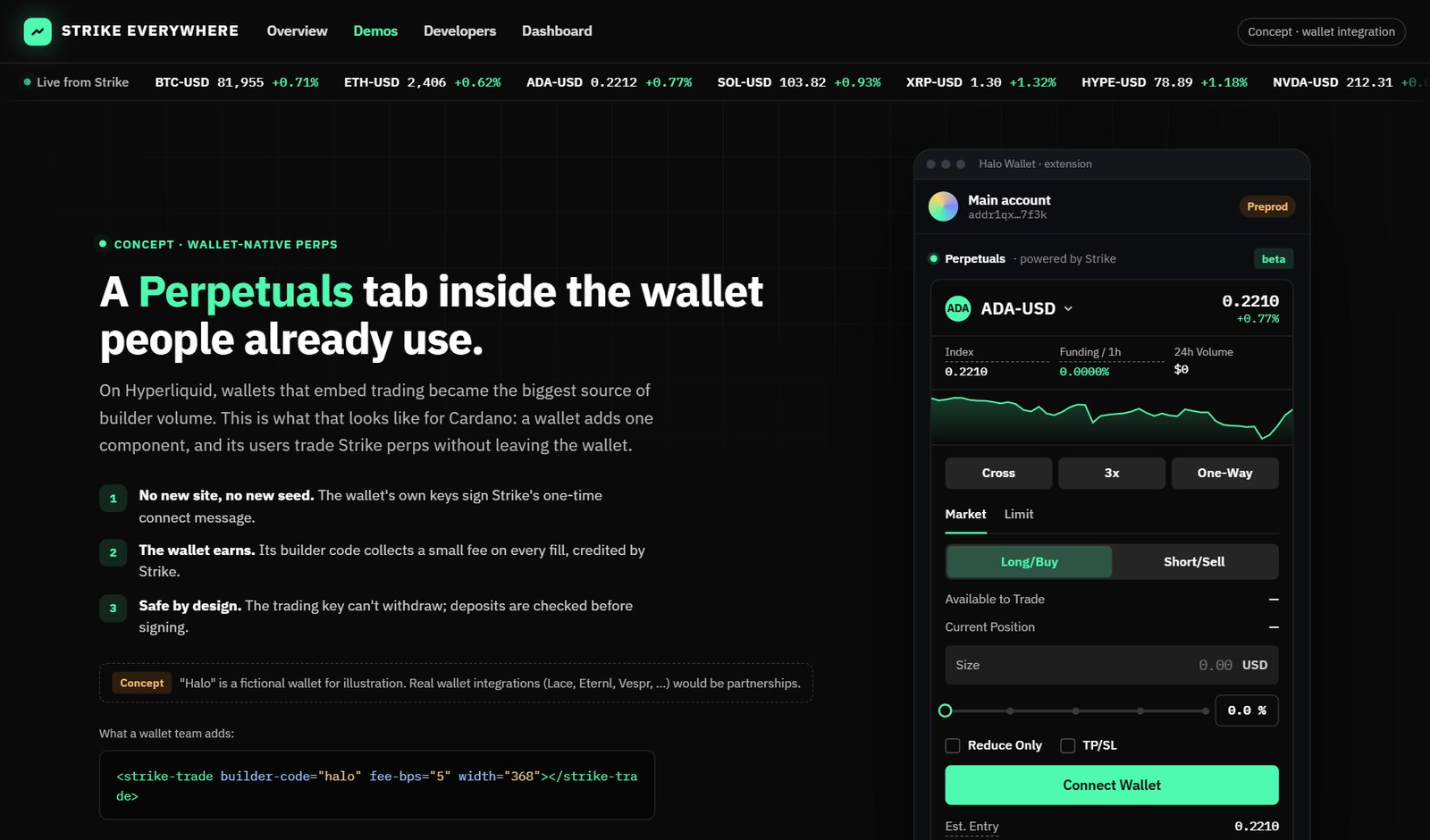
Same tag, four very different hosts

Every demo runs the real widget against Strike. Testnet by default; add ?network=mainnet&builder=CODE to go live.

Why it matters for Strike

Distribution, not incentives, is the bottleneck

Strike's builder program is already more generous than Hyperliquid's. What it lacks is the packaging that turns it into a growth channel.

$50B+

Perp volume Phantom routed to Hyperliquid through builder codes alone.

Crypto Briefing, Oct 2026
~40%

Share of Hyperliquid's daily users arriving through third-party front ends.

Blockworks via Dwellir, Jan 2026
10×

Strike's builder fee cap (1%) versus Hyperliquid's 0.1% on perps.

Strike & Hyperliquid docs
1

Tag brings Strike into any wallet, dApp, portfolio, newsletter or community, with every CIP-30 wallet their users already have.

Lace, Eternl, Vespr, Typhon, NuFi, Begin…
Integrate

Two lines. Your code, your fees.

Register a builder code at app.strikefinance.org/builder-codes, paste the snippet, and track results on the dashboard.

index.html


AttributeWhat it does
builder-codeYour Strike builder code (required)
fee-bpsBuilder fee per fill: 5 = 0.05%
max-fee-bpsFee cap the user approves at connect; defaults to fee-bps (Strike's hard cap is 100)
marketDefault market, e.g. ADA-USD, BTC-USD, NVDA-USD
sidesell for hedging flows
max-leverageSite-level ceiling for your audience
partner-idAttribution label shown on the dashboard
partner-apiWhere attribution events go; use the snippet's URL to get the dashboard (omit to turn tracking off)
persistsession keeps the user connected across reloads in this tab (12 h); default memory
widthPanel width in px (default 380)
networkmainnet or testnet
referral-codeOptional Strike referral code (yours, as the builder owner) applied when a new user's account is created
Security

Built so partners can't touch user funds

Keys stay in the browser

The trading key is generated client-side and can't withdraw: withdrawals need the user's own wallet signature and only go back to that wallet.

Deposits checked before signing

Strike's unsigned transaction is decoded and verified: exact amount, single output, no tokens. Otherwise the widget refuses.

Fees capped by the user

The fee cap is part of the message the user signs. Strike rejects any order above it, whoever the host is.